Friday, June 17, 2011

Neat coincidences...
There are so many amazing coincidences out there, it's hard not to believe that there is a higher power controlling the strings that are our lives.

Example...one of the guys I was hired with 20 years ago was in boot camp at Great Lakes the same time I was. We never met, but told several of the same stories.  Coincidence?  Probably.

Last night at the station, this same guy saw me studying info on Gettysburg, he told me that he had just done some family research and his great-great-great? grandfather fought for the 11th Pennsylvania Infantry during the Civil War.

The 11th Pa has one of my favorite monuments at Gettysburg...Sallie the pit bull is featured on their monument.  So obviously I had to find as much information as I could.

So here is a bit of what I have found and what Dave was able to tell me.

John B. McGrew (M'Grew)...Captain, Company G, 11th Pa, from West Elizabeth Pa, was 36 when he joined up on August 28, 1862, was wounded at Fredericksburg (I believe in the area of The Slaughter Pen Farm), and was discharged on March 15, 1865 on a surgeon's certificate.  Prior to the war he was a medical doctor, but wasn't used as one during the war, rather he was a company commander for an infantry unit.

The unit was engaged at the West Woods at Antietam, although I'm still trying to find muster rolls for the battle, I'm not sure if Capt. McGrew was with the regiment at that time as he had only joined a few weeks before.  From the time of his joining the regiment the 11th fought at 2nd Bull Run, Chantilly, South Mountain, Antietam and Fredericksburg where Capt. McGrew was wounded.  Again, I'm not sure which battles he may have fought in prior to Fredericksburg (but as I find out more info, I'll add it)

The 11th Pa Regiment had the distinction of being the oldest continuously serving regiment in the state at the time of the Civil War (serving since the American Revolution) first formed in Philadelphia on 10/25/1776.

This is a picture of the 1910 reunion of the 11th Pa at Gettysburg.  I'm not sure if Capt. McGrew was present here or if he fought at Gettysburg.  To be sure he knew of Sallie the regimental mascot.

11th Pennsylvania Regiment, 1910 reunion at Gettysburg

I'll keep on my buddy Dave, and keep doing research on Captain McGrew.  If you have anything that may help in my search, I'd be appreciative.

The picture of the 11th Pa Reunion was taken from the following website:  http://loyaltyofdogs.wordpress.com/2011/05/07/old-soldiers-remember-sallie/

Tuesday, June 14, 2011


A new week is upon me...
I started this week's study with the order of battle for the 3rd Corps of the Union Army.  I also downloaded a ton of maps from www.civilwar.org to help better understand the timing of events in the battle.  For the record civilwar.org is the site of The Civil War Trust, their main purpose is battlefield preservation.  This is a fine organization to belong to, and a fine charity to donate to as well.

Did anybody happen to see Gettysburg on the History Channel on Memorial Day?  It's been widely panned by many in the Civil War community.  My opinion is the cinematography was great, I liked the fact that Culp's Hill got mentioned, and for somebody with little knowledge or with a passing knowledge of the battle, it wasn't bad.  For anybody with an interest in the battle...there were many issues with this television show, things that were incorrect, or omitted outright to name a few.  But I won't get into that here.

I'm doing a lot of study of the first day of the battle right now, so for the next couple posts, I will post pix from that area of the battlefield.  Today we start with the First Shot Marker, and the Iron Brigade...enjoy


The first shot marker is located on US Rt 30 just a few miles west of Herr's Ridge (on the right as you travel west on Rt 30)
Fired by Cap Jones with Sergt Shafers Carbine, CO E 8th Ill Cavalary


First Shot, Gettysburg, July 1st 1863, 730 A.M.


7th Wisconsin, 1st Corps, 1st Division, 1st Brigade AOP
 McPherson's Ridge (on Stone Avenue), this monument was dedicated in 1888, they went into action with 370 men and lost 194 as casualties at Gettysburg.  Their war record listed on the other side of this monument shows they fought in 25 battles including Antietam, Gettysburg, Spottsylvania, The Wilderness, Cold Harbor and more, suffering 1157 casualties for the duration of the war.


2nd Wisconsin, 1st Corps, 1st Division, 1st Brigade, AOP
2nd Wisconsin, also dedicated in 1888.  They went into battle with 302 men and suffered 233 casualties.  In 1864 they were merged with the 6th Wisconsin as Companies G and H.  Located on Meredith Avenue on McPherson's Ridge.


24th Michigan, 1st Corps, 1st Division, 1st Brigade, AOP
Dedicated in 1889 and located on Meredith Avenue, McPherson's Ridge.  Went into battle with 496 men, suffered 323 casualties.  Served in AOP throughout the war fought in same battles as 2nd Wisconsin.  Was chosen as escort for funeral of President Abraham Lincoln.

\\


19th Indiana, 1st Corps, 1st Division, 1st Brigade AOP
Dedicated 1885, 339 men engaged in battle, 210 casualties suffered.  Fought most of the same battles as the rest of the 1st Brigade, eventually consolidated with the 20th Indiana in October 1864.  Also located on Meredith Avenue, McPherson's Ridge.


6th Wisconsin, 1st Corps, 1st Division, 1st Brigade, AOP
Dedicated 1888, located on Reynolds Avenue by the Railroad Cut.  340 men engaged in battle, 168 casualties suffered.  Served throughout the war, and was present at Lee's surrender at Appomattox.  


Other notes on the Iron Brigade Monuments
Notice that most of them have the 5 pointed star like shape on top that was the symbol of the Iron Brigade.  If you notice on each there is a red circle (except the 24th Michigan where it is just a grey circle) that was the symbol of the 1st Division of the 1st Corps of the Union Army.  The 2nd Wisconsin and 24th Michigan also have a Hardee hat which was unique to the Iron Brigade (they were known as the black hats).

Iron Brigade Medals of Honor at Gettysburg

Sergeant Jefferson Coates, Company H, 7th Wisconsin.  For unsurpassed courage in battle on 7/1/63 where he had both eyes shot out.  He received a brevet promotion to Captain for his actions as well.


Corporal Francis A .Waller, Company I, 6th Wisconsin.  For capture of the flag of the 2nd Mississippi Infantry on 7/1/1863.


The pictures of Sgt Coates and the 2nd Mississippi battle flag are not mine, I have taken them from the following web sites..
Sgt Coates:  www.findagrave.com
2nd Mississippi Battle Flag:  www.2ndmississippi.com

I hope you enjoyed this installment, please feel free to leave comments.  Until next time...

Sunday, May 22, 2011

Finally Feeling Better
After close to 2 weeks feeling like death, I'm finally feeling better.  My studies are progressing (not as fast as I'd like them to, but who am I to complain).

A friend of mine from work recently went to Charleston SC (which is on my list for this year, along with Gettysburg, Antietam (both again), and Manassas).  During his adventures he was nice enough to grab a model of the Hunley for me, as a Navy vet who served on a sub tender, I thought that was pretty damned cool of him.

And as my short term attention span goes...

The June 2000 issue of Civil War Times had an article on the best and worst monuments at Gettysburg, as one who was never afraid to give an opinion, I'll comment on their posts, and add a few suggestions of my own.

I threw in pictures where I have copies, the rest you have to look up on your own as I won't use somebody else's pictures here.  A great reference for pictures of monuments, please go to...http://www.drawthesword.goellnitz.org/


The 5 worst monuments (from 5 to 1) according to Civil War Times

21st Pa Cavalry
Yeah, a pretty funky looking monument, they suggested it looks like something from a Godfather movie, and I really can't disagree.
20th MA Infantry
Basically a large conglomerate type of rock on a pedestal.  Not the prettiest thing in the world, but it was taken from a playground in Roxbury, Massachusetts, so it's a part of home for those who couldn't return.  Among the complaints of the overall appearance, the writer also questions the validity of the story.

90th PA Infantry
A stone replica of a tree that was destroyed by artillery fire.  There is a bird nest as well as accouterments of battle.  Again a rather plain memorial, but the story behind the bird nest is it was allegedly dislodged during the battle and replaced by a member of the unit while under fire.


2nd NJ Infantry
Their complaint about this one is how it seems out of place, and seemingly representing an image of a nuclear warhead.  But in my opinion the Minie ball represents a major step forward in military technology, and is quite fitting on this battlefield.

Lt. General James Longstreet Monument
One of the most recent monuments on the battlefield, the Longstreet Monument was dedicated in 1998.  The two biggest complaints about this monument revolve around the size of the horse and the fact that the monument isn't on a pedestal.  The original design for the monument (which can be found in the visitor center)  was for it to be on a pedestal, similar to that of the Union corps commanders.  While I agree with the argument regarding the size of the horse, the monument is at ground level which brings it down from the godlike proportions of the others out there.

Original Design of Longstreet Memorial

Finished Product Longstreet Memorial


The 5 best (from 5 to 1) according to Civil War Times

73rd NY Infantry
As a firefighter and a veteran, this is one of my favorite monuments on the battlefield.  It's always on my must visit list.  The story behind the monument is great also, the representations are of two twin brothers of the 73rd NY, both of whom were killed during the war.


Gouverneur K. Warren Monument
A nice enough monument of the Chief Engineer from the Army of the Potomac.  But the location and views from it are what sets it apart from others.


State of Mississippi Monument
This was dedicated in 1973, again one of the more modern monuments.  It has an action scene of a member of Barksdale's brigade attacking a fallen Union color bearer.  For the most part, I'm not a fan of the modern monuments.  The older ones were of design approved by the regiments they represented, so there is a direct connection between the men who fought the battle and the monument they chose to represent their deeds and fallen comrades.  Not so with the modern monuments.  The things I do like about them (the modern monuments) is the time is put into the sculpture representing the units they depict, and they commemorate units that had nothing to represent their actions (Confederate troops more often than not).


State of North Carolina Monument
This was dedicated in 1929 so there is still a sense of connection with the men who fought here.  It shows multiple soldiers in an action pose, charging towards the enemy while being encouraged forward by a wounded comrade.  The detail in this bronze piece also makes it one I return to frequently.


Irish Brigade Memorial
I'm of Irish decent.  This is quite simply put, my favorite monument from any battlefield.  It represents the 63rd, 69th and 88th NY.  It is a large Celtic cross that has an irish wolfhound lying at its base as he waits for his master to return.

My take on the monuments of Gettysburg...
I have my favorites, and ones that I think are "better" than others.  But that being said, remember what I said while discussing the Mississippi monument.  The "older" monuments were of a design chosen an approved of by the members of the unit they represent.  Many of them actually depict a member of the unit.  There is a direct connect with the past and these monuments.

My List

42nd NY Tammany Regiment
They were from NYC, their monument shows a native american warrior...what is the significance?  On my not favorite list.

56th Pennsylvania
This must be on my "favorites" list as I  have taken several pictures of it.  I think I like the balance of the rifles with the colors in the middle.

11th Pennsylvania
Sometimes the story makes the monument special to me.  At the base of the monument is a pit bull named Sallie.  She was given to an officer in the regiment.  She was found after the battle protecting the bodies of her men.  She was killed in battle at Petersburg.

74th Pennsylvania
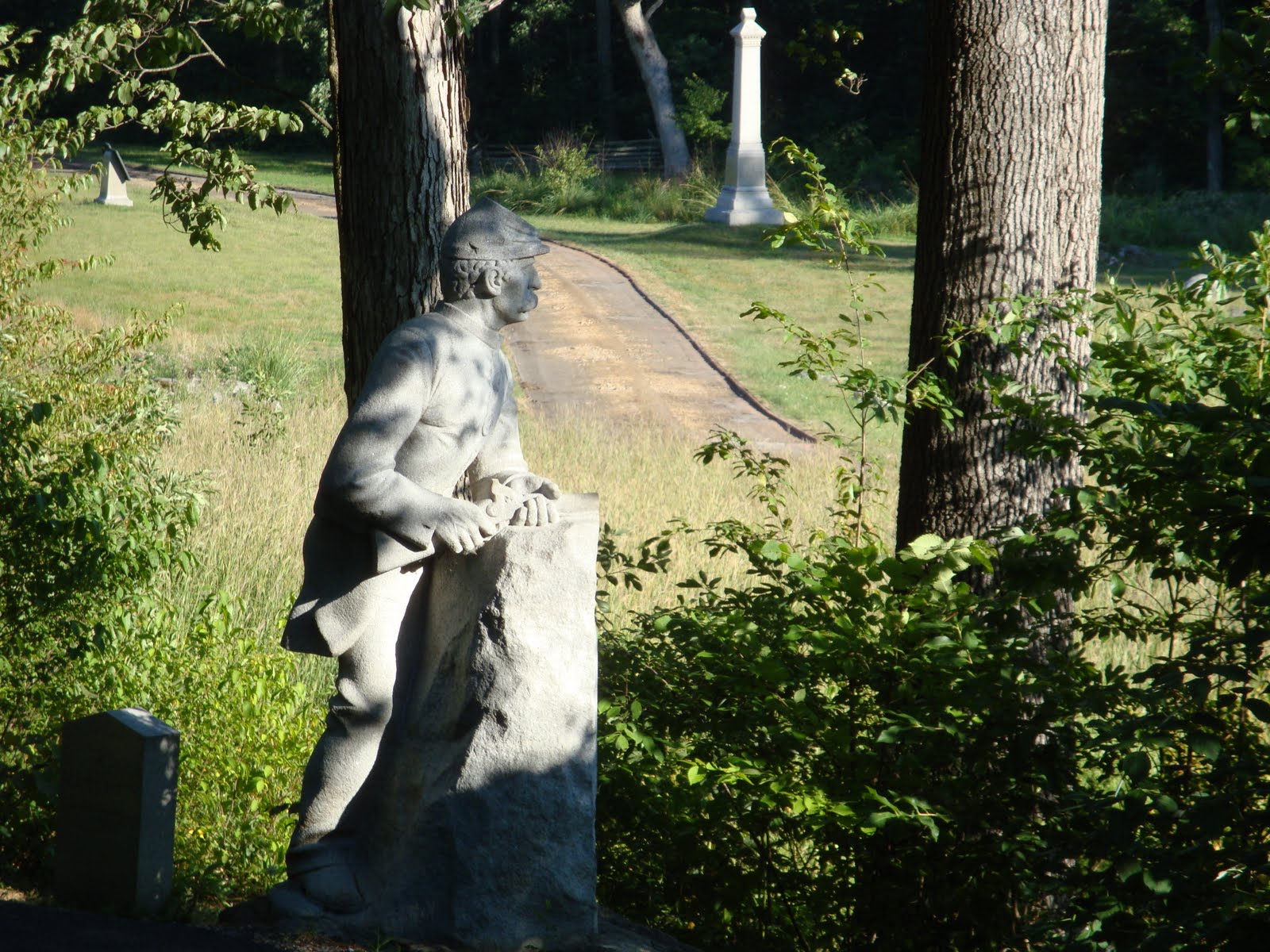
The detail in the soldier's face showing his sadness and anguish is moving to me.


 18th Pennsylvania Cavalry
Like the 21st PA Cavalry that was mentioned by the magazine article, this horse looks scared or perhaps in pain.  As far as monuments go, I find this one disturbing.

2nd Company Massachusetts Sharpshooters
This is a neat monument, it's missing the rifle (vandalism), but seen from the valley below, it's as if a soldier is looking down on you trying to decide whether or not to shoot.


116th Pennsylvania (Irish Brigade)
I'm on the fence with this one.  It's a beautifully done monument, depicting a soldier who was killed on Stony Hill.  There are days I really like this monument, and days that it just brings such feelings of sorrow.

Other Monuments I Like
Like the magazine article I didn't include the Pennsylvania or Virginia monuments.  But I am very fond of both.    

The Virginia monument depicts Lee on Traveller, with representations of every type of soldier that was part of the Army of Northern Virginia.

The Pennsylvania monument is the largest on the battlefield.  Among other items of interest are the bronze plaques on the outer perimeter of the monument that name every soldier from Pennsylvania who fought at Gettysburg.

The 40th New York monument.  This is by Devil's Den and depicts a soldier in laying down behind rocks looking to take a shot.

On the above list, as earlier stated, I like the Irish Brigade monument, 73rd New York, and the North Carolina monument.  

My lists of "best and worst" monuments aren't complete, there are somewhere in the neighborhood of 1300 monuments at Gettysburg, each has its positives and negatives.  The important thing to remember is what they commemorate.


One thing that breaks my heart and angers me is when I read stories about the vandalism of these monuments.  This is an ongoing issue.  Some monuments have been splashed with paint, others have had parts broken off of them, others still have been dragged (yes dragged) to the point of near destruction.  If you want to do something positive for the battlefield go to The Gettysburg Foundation and either donate your time or money.

Thursday, May 12, 2011

A Break From All Things Gettysburg (kinda)
I've been a bit under the weather this week, so my studies have suffered.  I spent a little time crawling around the web and found a site worth checking out.  It's called civilwartalk.com.  The people I've met so far are very knowledgeable about all things American Civil War.  There are break out discussion forums on everything from reenacting, and civil war politics to specific battles.  It's well worth the look.
Anyhow, one of the persons I met on the board mentioned they were considering a trip to Salinesville.  For the uninitiated, Salinesville is a little town in eastern Ohio that was the site of John Morgan's surrender.  It is also the site of the northernmost battle of the Civil War.
The town itself is very small, and there isn't much to commemorate the events there.  There are a few markers outside of town that I'll show here.
It's been a few years since I took the trip, and my memory is fuzzy.  I know that I used the book The Longest Raid of the Civil War by Lester V. Horwitz as a reference, and I'm inclined to say that I used Blue and Gray Magazine as a reference also, (but if I did, I have misplaced the copy)
So without further ado, here are some pictures from Salinesville Ohio.

This first picture is along Rte 158.  It is the marker commemorating Morgan's surrender to Major George Rue.  There is a picture out there of the dedication of this in 1910 with Rue and his wife flanking the marker.


This is the view looking east on Rte 158 from the marker, Morgan's men lined this road for over a mile after the surrender.


This is taken on Rt 93 just outside of Salinesville (it's kind of hidden in plain sight), it marks the sight of an engagement between Morgan's Raiders and troops under Union General James Shackelford.


These next two pictures are the the lay of the land next to the Shackelford / Morgan marker, in the first picture you can see Rte 93 on the left


This marker is at the intersection of Routes 164 and 55 just outside of Monroeville Ohio.  It explains the pursuit of Morgan's Raiders by Shackelford's troops.


The next 3 pictures are of the intersection of 164 and 55 showing the lay of the land around the previous monument.


Like I said earlier, there isn't a whole lot out there commemorating these battles.  Morgan's Raid started prior to and ended just after the battle of Gettysburg.  While it may have had impact locally, and diverted some resources that could have confronted Lee at Gettysburg, the overall impact of the Raid seems (to me at least) to have been minimal.

Wednesday, May 04, 2011

Why I do the things I do…

I was talking with a friend the other day, and he asked why I am working towards being a Licensed Battlefield Guide. “Is the money that good?” He asked.  I paused and thought for a few seconds and had an answer.

The sheer joy of learning is why I’m doing this.

I thought about all the things I had to memorize going through paramedic school that didn’t interest me a whit, and I realized that if I had that kind of focus and drive on a subject I cared about the results would be dramatic. 

I go to Gettysburg several times a year, and am never bored.  I always manage to find something new to see or learn about.  I don’t stick to the conventional there (or at any battlefield I visit).  I try to get off the trails and paths and see things from a different perspective.  I know more about the battle than a lot of people out there, but not nearly as much as others. 

How could I improve my knowledge on this subject?

Reenacting?  Not for me…I was in the military for four years and remember why I got out.  Plus when you have to work to stay “in character” it seems like you are working too hard to enjoy what you’re there for.

Reading?  I’ve always been a voracious reader, but how would I be able to measure my progress?

Write a novel?  Good Lord no!!!  There are much better authors out there than I could ever hope to be who have already written a ton of books on Gettysburg and the Civil War as a whole.  And if I couldn’t add anything substantial to the conversation, I probably shouldn’t try to get in on it.

Then I found out about the LBG test.  That is a way I could measure my knowledge.  They hit on so many topics on the battle that you have to have a deep understanding of the battle to even consider taking the test.

I set the goal for myself to be able to pass the written test.  If I can pass the written test, then I will be satisfied.  I know going into this that they only create a very few LBGs every two years, and that achieving that may be beyond what I am capable of. 

On another track...

I have an affinity for the Civil War.  I’m not sure what the draw or attraction to it is.  My family wasn’t in the US when the war was waged, so I have no direct ties.  

There is closeness in that several battlefields are within a 4-6 hour drive from my house, but the same argument can be made about the French and Indian War and The Revolution.  

There is something truly special about the Civil War.  It was the first war to be widely photographed.  It was a war of innovation (both strategically and with weaponry).  In a sense it was the first "modern" war.It forever changed so many things; how we perceive ourselves as a nation; the face of both the North American continent and the world.  It was a war initially fought because of constitutional interpretation, that later became identified with a higher meaning.

I don’t profess to have this great knowledge of history, or even the Civil War.  I don’t have a degree of any type.  I have the knowledge I’ve gained through self directed research, and opinions that I have formed based on my interpretation of the facts as I learn them.  I hope to share some of them here as I add more posts.

Next week's post will include pictures (from where, I haven't decided  yet).

Monday, April 25, 2011

Another week of studying and memorization complete...

I've managed through repetition and memorization to lock down the order of battle from the entire 1st Corps through the 2nd Division of the 2nd Corps down to the regimental level.  It's amazing how much you can absorb when you put your mind to it.

Recently (earlier this month), I was in Gettysburg and managed to find my way up to Neill Avenue (also called Lost Lane).  There is a narrow goat path that leads from a dead end street, down to a stream bottom, and back up a steep hillside.  The route to the area isn't marked anywhere that I am aware of, and it is not handicapped accessible.  The trail is about 8-10' wide and is bordered by private property.  This I know because the landowner managed to hang "No Trespassing" signs on just about every tree that bordered the trail.  The area of Neill Avenue is the extreme right position of the Union Army at Gettysburg.  Here are some pictures I took, enjoy.


This is the original marker for Neill Avenue, visible in the second picture on the right hand side.

The view from the beginning of Neill Avenue.  Note that the property on either side is privately owned.

Neill Avenue is actually in a couple of parts along this ridge line.  This area has a wire across either end, possibly to impede horse traffic as there were a lot of tracks in the area and on surrounding trails.  A few hundred yards beyond this picture is a second area with monuments.


This is the monument to the 49th NY Infantry on the lower end of Neill Avenue, they were in the 6th Corps and assigned to this position on the 3rd of July, 1863.


This next monument I really took a shine to.  I really like the "Union Shield" design of it with the 6th Corps insignia in the middle.  This monument is to the 7th Maine Infantry who were also assigned here on July 3rd.

Looking downhill on the right hand side you can see the 7th Maine Monument, and close to center you can see the monument to the 49th New York.


A little further up Neill Avenue and to the left we find a monument to the 43rd New York Infantry, they were assigned here on the 2nd of July.  They had an impressive battle history including the Peninsula Campaign, the 7 Day's Battle, Antietam, Fredericksburg, Gettysburg (obviously), Grant's Overland Campaign, Petersburg, and Appomattox (to name a few)


Just a few steps from the 43rd NY Monument is a marker for the 3rd Brigade, 2nd Division of the 6th Corps.


Looking back down at the first section of Neill Avenue you can see the 3rd Brigade marker and the 43rd NY Monument.

Nearing the end of Neill Avenue (the second part of it) we approach the monument to 61st Pennsylvania.  They held the position of the extreme right of the Army of the Potomac at Gettysburg.  After marching 37 miles, they arrived at Gettysburg on July 2, 1863 and were assigned to assist the 12th Corps, they were moved to this position on the morning of July 3rd. 


 Finally we reach the marker denoting the extreme right of the Army of the Potomac.  The little stone marker on the right is a flank marker from the 61st Pennsylvania.  You can tell where the Park Service property ends by the "No Trespassing" sign on the tree in the background.  Maybe it's me, but if you own property in a historic area, shouldn't you be willing to accept that people are going to want to be there?

Tuesday, April 19, 2011

The memorization by repetition process continues, I'm 100% with the 1st Corps, and am through the 1st Division of the 2nd Corps (with 100% accuracy).

For the record my reading and listening list these days are rather short...
I'm presently reading Gettysburg The First Day by Pfanz, and listening (on my IPOD) to Gettysburg by Sears.

If you're interested there are several great books out there on the topic...The Gettysburg Campaign (A Study in Command) by Coddington; any of the Gettysburg series by Pfanz; for battlefield knowledge a new book that has only been out for a year or so is The Complete Gettysburg Guide by Petruzzi and Stanley.

There are also several websites out there that are a great reference...

Gettysburg Daily http://www.gettysburgdaily.com/  (a site run by several licensed battlefield guides), this site has a wealth of information specifically on the battlefield and surrounding area;

The Battle of Gettysburg Resource Center http://gburginfo.brinkster.net/index.htm; it's not updated often, but has a lot of basic information to get you started.

The Civil War Trust http://www.civilwar.org/welcome/ (formerly the Civil War Battlefield Preservation Trust); this group's focus is battlefield preservation, they are a great charity and use donations to purchase threatened battlefield properties to ensure availability for future generations, they also have great maps and additional information on battles.

and Stone Sentinals http://www.stonesentinels.com/, they have pictures and information on the monuments of several battlefields.

There are others that I go to as well, and in the future I will add information on those sites as well.
Happy studies.

Saturday, April 16, 2011

More period graffiti from Gettysburg...

My studies are progressing, and I'm most of the way through the 1st Division of the 2nd Corps...but nice weather and my motorcycle are both calling out to me.

Anywho, here are some more pictures and descriptions of period graffiti from the Gettysburg Battlefield.  As I said in my last post, the pictures posted here are ones I have taken myself.

These first two are from the George Spangler Farm, they are on the out building that General Armistead was taken to after being mortally wounded during Pickett's Charge.  I'm not sure the time frame that they are from, but this is from a not very widely traveled part of the battlefield, in fact when the pictures were taken was right after the park service took ownership of these buildings.  The first one is on the door to the building, the second picture is of the windowsill.  


This next one is by the 40th NY Memorial below Devil's Den and next to the Valley of Death, it is believed to predate the 1888 dedication of the 40th NY memorial.


This is taken atop a large boulder in the area of the Valley of Death...experience being hindsight, don't try climbing up here to take this picture unless you have somebody to help you down (getting up there was the easy part)...what you're looking at is a very faint outline of the US Flag, the rock is known as Flag Rock conveniently.  There is another carving up there, the initials UFS 1873.


Just inside Devil's Den near the 4th Maine memorial is this engraving to the 4th Maine.  Now quite easy to find and darned near in plain sight, this was "rediscovered" in 1993 by Licensed Battlefield Guide Timothy Smith after brush was cleared from the area.


 This one is in plain sight across from the Irish Brigade Memorial (by the memorial plaque to the 28th Massachusetts Field Hospital), it's easy to miss though.  Not sure who PB is...
This is the same rock from a distance...can you see the PB?


This next rock is the David Acheson Rock.  Acheson was a Captain with the 140th Pennsylvania Infantry, he was killed in the Wheatfield, he was buried just inside the woodline at the Weikert farm and the stone was marked with his initials and regiment so his family could retrieve the body at a later time.  His remains were returned to Washington County (Pa) about 2 weeks after the battle.

This next mark is next to the NY memorial on Little Round Top and is dedicated to Col. Strong Vincent who was mortally wounded near here. (Vincent was promoted to Brigadier General for his actions on Little Round  Top)

Over by Spangler Spring is the "Coble Rock", this one is fairly well known and is inscribed with "AL Coble 1st NC REG"
Private Augustus Lucian Coble served w/ Company E, 1st North Carolina Infantry as a color bearer during the battle.  It is believed that in 1913 at the 50th reunion of the battle, he made this marking.
A wide shot of the Coble Rock.


The Daniel Lady Farm on Hanover Road was used as a field hospital for Ewell's Corps, carved on a beam in the barn are 2 sets of initials, this first reads, "BAR, 23VA" and has been identified to Private Benjamin A Roberts, from Company K of the 23rd Virginia Infantry.


The second carving at the Daniel Lady Farm reads, "ABE 3NC" and has been identified to Private Aaron E Eubanks, Company G of the 3rd North Carolina Infantry