Tuesday, September 06, 2011

I Love this Amateur Historian Thing...

I Love this Amateur Historian Thing...

So as things go, my younger Brother's Father-in-Law really has enjoyed the posts about his Great-Great-Grandfather (E.L. Whittelsey).  During his wanderings he found the grave of his ancestor (I believe it's in Erie).

Grave of Capt. Edward L. Whittelsey 83rd Pa Vols.


Sorry the pic is a little blurry, Jim sent me a small copy of the picture (Facebook wouldn't let me "borrow" a large version) and it didn't stand up to being enlarged.  It's still pretty cool though.

As the story goes, another coworker of mine (Don Straw), who while in his travels to various Civil War sites was kind enough to remember me and grab a few souvenirs for me, was telling me of his ancestor Hiram Straw (multiple great uncle, just not sure how many greats LOL), who served with the 50th Pennsylvania Volunteers.  So I have another diversion for all to enjoy...


50th Pennsylvania Volunteer Infantry

Major events and Battles Participated in:  Organized at Harrisburg 10/1/1861; ,Spotsylvania; Second Bull Run; North Anna; Chantilly; Bethesda Church; South Mountain; Cold Harbor; Antietam; Petersburg; Fredericksburg; Vicksburg; Siege of Knoxville; The Wilderness;  Grand Review, Mustered out July 30, 1861.

Recruited in Schuylkill County, Reading Pa, Berks County, Susquehanna County, Lebanon Pa, Lancaster County, Bradford County, Chester Pa, Luzerne County.


Commanding officer:  Colonel Benjamin Christ.

There were 2 members awarded the Medal of Honor:  

Sergeant Charles Brown, Company C, 50th Pennsylvania Infantry.  
Citation: Capture of flag of 47th Virginia Infantry (C.S.A.) at Weldon Railroad, Va., 19 August 1864. Date of issue: 1 December, 1864.

Corporal Henry Hill, Company C, 50th Pennsylvania Infantry. 
Citation: This soldier, with one companion, would not retire when his regiment fell back in confusion after an unsuccessful charge, but instead advanced and continued firing upon the enemy until the regiment re-formed and regained its position. At Wilderness, Va., 6 May 1864. Date of issue: 23 September 1897.


Information on Hiram Straw:  Enlisted Sept. 9, 1861 as a private in Harrisburg Pennsylvania.  He was 5'4" and 27 years old at time of first enlistment and was a Miller residing in Tremont Pennsylvania prior to joining up.
He reenlisted on January 1, 1864 at Blanes Crossroads in Tennessee. Some time following he was promoted to the rank of Corporal.He was taken prisoner on May 12th 1864 at the battle of Spottsylvania Courthouse.  He died of disease in New Zingston Kentucky while a prisoner of war, on or about March 31, 1864


50th Pa in parade formation in Beaufort SC February 1862.


As I find additional information, I will try to add it.  If you have any comments or additional information, please feel free to add.

Saturday, September 03, 2011

The 1st Corps, 2nd Division, 2nd Brigade
Also known as Baxter’s Brigade

During the battle of Gettysburg, it served as a member of Robinson's Division of the First Corps, Army of the Potomac.

The plaque to the brigade reads:
"On July 1. Arrived about noon took position on right of Corps on Mummasburg Road. Repulsed an attack of Col. O’Neal’s Brigade then changed front and with the assistance of Second Brigade First Division captured 1000 prisoners and three stand of colors of Brig. Gen. Iverson’s Brigade. Afterwards relieved by First Brigade and retired to the Railroad Cut to support Battery B 4th U. S.
At 4 P. M. retired to Cemetery Hill and constructed breastworks. The 11th Penna. was transferred to the First Brigade.
July 2. About 10 A. M. relieved by Second Brigade Second Division Second Corps and placed in reserve. At 4 P. M. supported a battery of Eleventh Corps. At sunset moved to the support of Third Corps then returned to support of Eleventh Corps.
July 3. Moved to the rear of the cemetery early in the morning in support of Twelfth Corps. At 2 P. M. formed on right and rear of Third Division Second Corps and there remained until the close of the battle. The Brigade went into action with less than 1200 men.
Casualties Killed 7 Officers 3 Men Wounded 31 Officers 227 Men Captured or Missing 12 Officers 338 Men Total 648"

Baxter was wounded four times during the war.   Baxter’s brigade arrived around noon just as Confederate Maj. Gen. Robert Rodes’s division began to appear on Oak Hill. Baxter’s brigade deployed along the Mummasburg Road. A Confederate brigade under Colonel Alfred Iverson advanced without skirmishers and moved past Baxter’s men, who were hidden behind a stone wall. Suddenly, Baxter’s brigade rose up and delivered a lethal fire into the North Carolinians. In one of the most one-sided exchanges during the war, Baxter’s surprise attack killed, wounded and captured 758 of 1300 men in Confederate Iverson’s brigade. Baxter’s men eventually withdrew to the north end of Cemetery Ridge, having lost all of the officers on Baxter’s staff and close to half the brigade in defense of the I Corps right flank.

Brigadier General Henry Baxter


97th New York Infantry
97th New York Infantry Monument
Located on Doubleday Avenue. It indicates the position occupied by the 97th (also known as The New York Conkling Rifles) on the afternoon of July 1, 1863. They counterattacked Iverson’s Brigade and captured 213 members of the 20th North Carolina Infantry. They eventually retreated through the town of Gettysburg

Dedication Date: July 1, 1889.  (26th anniversary of the actions in commemorates)
Survivors of 97th NY at dedication of their monument.  Picture from www.oneidacountyhistory.org/backintime/GettysburgMonument.asp


Commander: Col. Charles Wheelock Wounded and captured on July 1. He escaped during Lee's retreat eventually rejoining his regiment

Number Engaged: 255

Casualties: 12 killed, 36 wounded, 78 missing

Raised: Herkimer, Lewis, and Oneida counties.
Organized at Boonville, N.Y., and mustered in February 18, 1862, mustered out July 18, 1865.

Major Battles or Events:  2nd Bull Run, Antietam, Fredericksburg, Chancellorsville, Overland Campaign, Petersburg, Appomattox and the Grand Review 
*The Grand Review wasn't a battle, but a final review of the army through Washington DC.


88th Pennsylvania Infantry

88th Pennsylvania Monument

Located on Oak Ridge, on Doubleday Avenue.The monument indicates the position in the brigade line held by the 88th Pennsylvania Infantry on the afternoon of July 1, 1863.

Dedication Date: September 11, 1889.

Original cost of the monument was  $3,000.00.  There are several items on the top of the monument that represent important items from the daily lives of the soldiers of the regiment.  They include: cannons;  a trumpet; a revolver;  a flag; a drum; a sword; a rifle; a kepi hat; a canteen;  and haversack with bedroll,  all topped with an eagle.

Close up of top of 88th Pennsylvania Infantry Monument


The 88th Pennsylvania Infantry was also known as The Cameron Light Guards.

Raised: Philadelphia and Berks County
Organized at Philadelphia September, 1861 Mustered out June 30, 1865. 

Commander: Maj. Benzet F. Foust  Wounded on July 1.

Major Battles or Events:  Cedar Mountain; Second Bull Run; Antietam; Fredericksburg; Chancellorsville; The Wilderness; Spotsylvania; Cold Harbor; Petersburg; Appomattox; Grand Review

Number Engaged: 296
Casualties: 4 killed, 55 wounded, 51 missing

Medal of Honor Awardee: Edward L. Gilligan
Place and date: At Gettysburg, Pa., 1 July 1863.
 Date of issue: 30 April 1892. 
Citation: Assisted in the capture of a Confederate flag by knocking down the color sergeant.

Edward Gilligan MOH

Secondary Monuments and Markers
There are 3 additional or Secondary Markers to the 88th Pennsylvania.  I don't presently have pictures of them, but will tell you where they are, in the future I will do a post just of secondary markers.

Location: Forney Field, accessed via a trail from the monument along Doubleday Avenue. Marker is west of the Oak Ridge Tower parking area.  It represents the advanced position held by the regiment on July 1, 1863.

Location: South Hancock Avenue, Cemetery Ridge. South of the Pennsylvania Monument.  It represents the position held by the regiment on the 2nd of July 1863


Location: Ziegler’s Grove, North Hancock Avenue, southwest of the old visitor center parking area.  It represents the position held by the regiment on July 3rd 1863.


12th Massachusetts Infantry
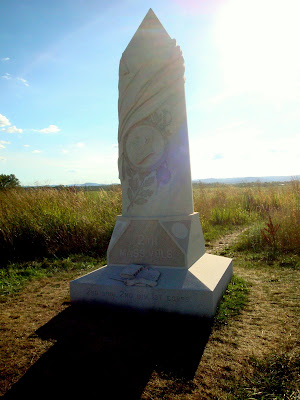
12th Massachusetts Monument

Located on Oak Ridge, Doubleday Avenue. It designates the place where the regiment was placed behind the stone wall on July 1.

Dedication Date: October 8, 1885.
Has a relief of Daniel Webster and a flag on the body of the sculpture with a cartridge box, bayonet and scabbard on the base.  The monument had a cost of $500.


Secondary Monuments and Markers
There are two secondary markers showing different positions taken by the 12th Massachusetts.  Where I have pictures I will post them.
Location: South Hancock Avenue, Cemetery Ridge.
Description: Denotes the location of the regiment on July 2, 1863.

Secondary Marker to 12th Massachusetts Infantry, located on South Hancock Avenue.


Location: North Hancock Avenue, Ziegler’s Grove.
Description: Marker denotes the regiment’s position on July 3, 1863.

The 12th Massachusetts Infantry was also known as The Webster Regiment.  Note that Daniel Webster was represented on their main monument.

Commander: Col. James L. Bates wounded on July 1. Lt. Col. David Allen, Jr.

Number Engaged: 301

Casualties: 5 killed, 52 wounded, 62 missing

Raised: Essex, Norfolk, Plymouth, and Suffolk counties.
Organized at Fort Warren and mustered in June 26, 1861 Ordered home for muster out June 25. Mustered out July 8, 1864.

Major Battles or Events:   Cedar Mountain; Second Bull Run; Antietam; Fredericksburg; Chancellorsville; The Wilderness; Spotsylvania; Cold Harbor; Petersburg


83rd New York Infantry

83rd New York Infantry Monument
Located on  Doubleday Avenue, Oak Ridge.  It indicates the position held by the regiment during the afternoon of July 1, 1863.


Dedication Date: July 1, 1888.  (25th anniversary of actions it commemorates)

This monument cost $6,000.00. It was the first monument dedicated to a regiment recruited from New York City

The 83rd New York Infantry was also known as City Guards.


Commander: Lt. Col. Joseph A. Moesch


Number Engaged: 215


Casualties: 6 killed, 18 wounded, 58 missing


Raised: New York City
Volunteered for three years’ service.  Mustered in at Washington June 8. 1861.  Veterans and Recruits transferred to 97th New York Infantry June 7, 1864 (end of 3 years' service).  Regiment mustered out at New York City June 23, 1864, expiration of term

Major Battles:  2nd Bull Run, Antietam, Fredericksburg, Chancellorsville, The Wilderness, Spotsylvania, Cold Harbor


90th Pennsylvania Infantry
90th Pennsylvania Monument
Located on  Doubleday Avenue on Oak Hill, it represents the position the unit held on the afternoon of July 1, 1863.


Dedication Date: September 3, 1889.


The monument resembles a branchless oak tree with several objects hung on it, including:  a knapsack; cartridge box; and a rifle.  There is also bronze "ivy" growing around the tree.  There's a bird's nest on the upper part of the tree with a robin above the nest.  There is a a story that during the battle, a member of the regiment saw a nest fall from a tree, and replaced the nest in the branches from which it fell. 


Secondary Monuments and Markers
There are 2 secondary markers and one additional monument to the 90th Pa.  Where I have pictures, they are posted, otherwise a description will have to suffice for now.


 Memorial  to Rev. Horatio Howell.
Location: On  the steps of the Christ Lutheran Church on Chambersburg Street in Gettysburg there is a memorial stone to Reverend Horation Howell marking the area where he was killed.
It was erected by the Survivors Association of the 90th Pennsylvania Volunteers and friends of  Rev. Howell.  Howell was shot to death on the steps of the church as the Gettysburg battle began. 
On March 13, 1862, he enlisted as the regimental chaplain of the 90th Pennsylvania Infantry in Philadelphia.
Dedicated September 1, 1889. 


Location: Ziegler’s Grove, North Hancock Avenue.  Represents positions held on July 2 and July 3, 1863.
Inscription: “Non sibi sed patraie” (Translates to "Not for self, but for country")


Rear view of 90th Pa Secondary Marker
for July 2 and 3 1863
Front (road) view of 90th Pa Secondary Marker


The monument is interesting in that it has corps symbols from both the First and Fifth Corps (circle inside Maltese cross in picture on right)


 South Hancock Avenue near the Pennsylvania Monument.  It represents position held on July 2, 1863 during Barksdale's attack.

Description: A large native boulder with bronze plaque affixed, erected in 1889 by Commonwealth of Pennsylvania. 


90th Pa Secondary Marker for July 2, 1863


 The 90th wore a chassuer uniform.
Organized at Philadelphia October 1, 1861 Consolidated with 11th Pennsylvania Infantry November 26, 1864.


Raised: Philadelphia.


Commander: Col. Peter Lyle


Number Engaged: 208


Casualties: 8 killed, 45 wounded, 40 missing


Medal of Honor Awardee
Major Alfred J. Sellers
Place and date: At Gettysburg, Pa., 1 July 1863.
Date of issue: 21 July 1894.
Citation: Voluntarily led the regiment under a withering fire to a position from which the enemy was repulsed.
Major Alfred J. Sellers MOH


11th Pennsylvania Infantry


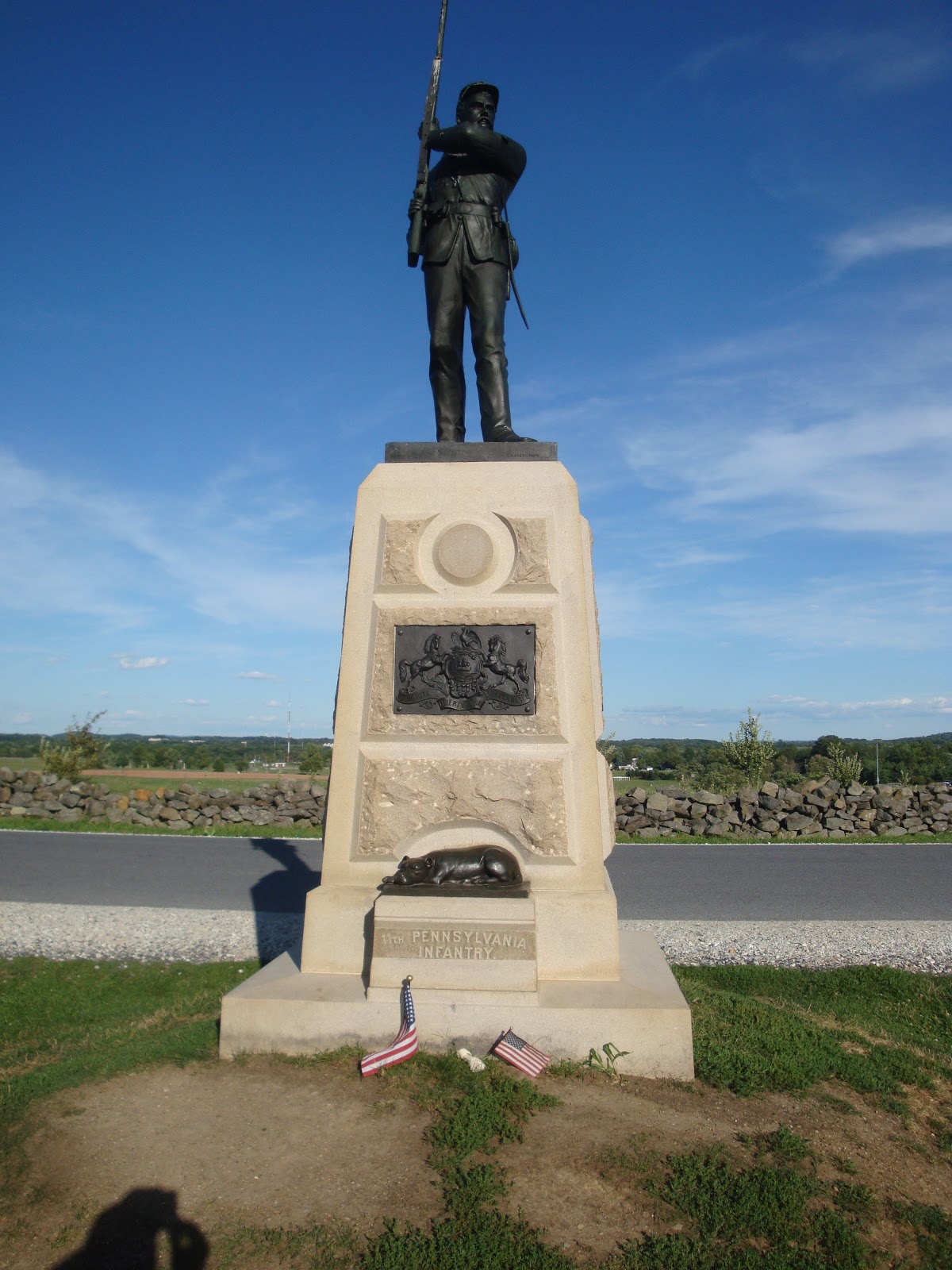
11th Pennsylvania Monument
Located on   Doubleday Avenue on Oak Ridge.  The monument indicates the position held by the 11th Pennsylvania Infantry on the afternoon of July 1, 1863


Dedication Date: September 3, 1889.


Description and Notes:. A uniformed Infantryman stands atop the pedestal.  On the base lies the regimental dog.  Sallie, the regimental bull terrier mascot, was found after the battle guarding the wounded and dead of her regiment.  She was with the regiment through the Siege of Petersburg where she was killed.

The 11th Pennsylvania Infantry was also known as The Bloody Eleventh having received the nickname at the Battle of Falling Waters, Virginia in July of 1861. 


Commander: Col. Richard Coulter, Sr.


Number Engaged: 292


Casualties: 5 killed, 52 wounded, 60 missing


Raised: Latrobe Pennsylvania (organized in in Westmoreland County Pennsylvania) August 1861.
 Mustered out July 1, 1865

Major Battles and Events:  Cedar Mountain; Antietam; Fredericksburg; Chancellorsville; Regiment reenlisted January 5, 1864; The Wilderness; Spotsylvania; Cold Harbor; Petersburg; Five Forks; Appomattox; Grand Review

As usual, I hope you enjoyed this post, please feel free to comment.

Thursday, September 01, 2011

Just a Follow Up Between Posts

I've been out gallivanting for the past week and a half (my niece came in from the west coast and it was my birthday week, so obviously battlefield visits were involved).  I managed to get to Gettysburg for a 3 day visit, then Antietam and Harper's Ferry...it was busy but fun.
Anyhow, I said as I got more information about my buddy Dave's Great-Great-Great Grandfather and my Brother's Father-in-Law's Great-Great Grandfather, I'd post about them...
Well, Dave has just completed the paperwork (with the help of another coworker) to receive the military records of his ancestor.
When I went to Gettysburg, I made a point of checking out the Pennsylvania Memorial, for the uninitiated, it has the names of every Pennsylvanian who fought at Gettysburg on it.  So in the spirit of following up, please enjoy the following...

The Pennsylvania Memorial seen from the area of the Meade Monument
If you look at the base of the memorial you can see how it appears dark, that area is bronze plaques listing every Pennsylvanian who fought at Gettysburg, by Regiment, Company and Rank.  Those who were mortally wounded have a star next to their name.

83rd Pennsylvania's plaque on the Pa. Memorial.  E.L. Whittelsey's name appears on the top right of this plaque as part of the command staff of the regiment.

In the upper right corner you can see Whittelsey's name listed as Sergeant Major (the rank he held at Gettysburg), he was  commissioned 2nd Lieutenant just about a  year later, and promoted to 1st Lieutenant of Company A in October of 1864.  He was wounded at Malvern Hill in July 1862, and again at 2nd Bull Run (or 2nd Manassas if you prefer) where he was taken prisoner.


11th Pennsylvania Plaque on Pa. Memorial, Company G which was Capt. McGrew's company is about 1/2 way down on this plaque.


Capt. John McGrew was in charge of Company G of the 11th Pa.  He was wounded at Fredericksburg (December 1862) and was discharged in 1865 on a surgeon's certificate.
Again, as I find more information on these gentlemen, I will post it (I'm hoping to get a peek at the military records Dave McGrew sent for).


Thursday, August 11, 2011

1st Corps Information Continues
1st Brigade, 2nd Division, 1st Corps
Army of the Potomac

The 1st Corps, 2nd Division, 1st Brigade was also known as Paul’s Brigade. During the battle of Gettysburg, it served as a member of Robinson's Division of the First Corps, Army of the Potomac.
Commanders at Gettysburg included Brig. Gen. Gabriel R. Paul who was wounded and replaced by Colonel Samuel H. Leonard of the 13th Massachusetts.
Brigadier General Gabriel Rene Paul (Blinded at Gettysburg)
Col Leonard was wounded on July 1, and was replaced by Col. Adrian R. Root from the 94th New York.  Root was wounded and taken prisoner by Confederate troops on July 1 and was replaced by Col. Richard Coulter from the 11th Pennsylvania of the Second Brigade, Second Division, First Corps.  Coulter suffered a slight wound on July 1, but continued leading the brigade only ceding control to Col Peter Lyle of the 90th Pennsylvania (also of the 2nd Brigade) for a few hours on July 3rd and then finally ceding to Lyle on July 5th.

The Brigade consisted of troops from the 16th Maine, 13th Massachusetts, 94th and 104th New York, and the  107th Pennsylvania Infantry.

Monument marking area fought for by 1st Brigade, 2nd Division, 1st Corps.

Corps Marker just west of Doubleday Avenue on Oak Ridge.  Note the Eternal Peace Light Memorial in background.


Brigade History at Gettysburg (per Brigade Marker)

July 1
Arrived about noon and went into position on the ridge near the Seminary and threw up Breastworks. About half past 2 R M. moved to the right of Corps in support of Second Brigade. Repulsed repeated attacks and was engaged until 4 R M. then retired to Seminary Ridge and constructed Breastworks. The 11th Pennsylania. was transferred from the Second Brigade.

July 2
About noon relieved by Third Division Second Corps and went to rear in support of batteries on Cemetery Hill. At sunset moved to the left to support the Third Corps and returned to Cemetery Hill.


July 3.
 At 9 A. M. went to support of Twelfth Corps and at 3 P. M. to the left and took position on right of Second Corps in support of a battery and there remained until the close of the battle.
Casualties Killed 2 Officers 49 Men Wounded 36 Officers 321 Men Captured or Missing 40 Officers 593 Men Total 1041


16th Maine Infantry

16th Maine Infantry
 Doubleday Avenue 

Monument indicates the first position held by the 16th Maine Infantry on July 1, 1863.
Dedication Date: October 3, 1889.  

Secondary Monuments and Markers:  Intersection of Doubleday Avenue and Mummasburg Road  Small stone position marker denotes the location held by the 16th Maine at 4 PM on July 1, 1863

Secondary Monument to 16th Maine at Intersection of Doubleday Avenue and Mummasburg Road

Commander: Col. Charles W. Tilden (1832-1914).  Captured on July1 .

Number Engaged: 311

Casualties: 9 killed, 59 wounded, 164 missing

Regimental History:Organized at Augusta Maine and mustered in August 14, 1862 Mustered out June 5, 1865. Recruits transferred to 20th Maine Infantry. Regiment lost during service 9 Officers and 172 Enlisted men killed and mortally wounded and 2 Officers and 257 Enlisted men by disease. Total 440.


94th New York Infantry
94th New York Infantry Monument
Doubleday Avenue, Oak Ridge 
Indicates the position held on the afternoon of July 1, 1863 until forced to retreat by Confederate pressure .

Dedication Date: 1888. 
 Main Inscription: DULCE ET DECORUM/EST PRO PATRIA MORI 
The Regiment was also known as Belle Jefferson Rifles
Number Engaged: 445

Casualties: 12 killed, 58 wounded, 175 missing

Raised: Jefferson County New York. The 94th was formed from a consolidation of the 94th and 105th Regiments.

Regimental History
Organized at Sackett’s Harbor, N.Y., and mustered in March 10, 1862.
Mustered out July 18, 1865. Regiment lost during service 5 Officers and 105 Enlisted men killed and mortally wounded and 137 Enlisted men by disease. Total 247.


13th Massachusetts Infantry

13th Massachusetts Infantry
Located on Robinson Avenue near base of Oak Hill. Marks position held by 13th Massachusetts Infantry July 1, 1863 prior to retreat of Paul’s Brigade to Cemetery Hill.
Dedication Date: October 1885.
Full-length figure of uniformed Color Sargent Roland G. Morris The monument also indicates the spot where color sergeant Roland G. Morris fell

Commander: Col. Samuel H. Leonard (1825-1902). Wounded slightly on July 1.

Number Engaged: 284

Casualties: 7 killed, 77 wounded, 101 missing

Raised: Middlesex, Norfolk, Suffolk, and Worchester counties Massachusetts. 
Organized at Fort Independence June 16, 1861 Mustered out August 1, 1864. Regiment lost during service 4 Officers and 117 Enlisted men killed and mortally wounded and 40 Enlisted men by disease. Total 161.


104th New York Infantry

104th New York Infantry Monument
Located on Robinson Avenue, Oak Ridge
Dedication Date: September 4, 1888.
Regiment was also known as The Wadsworth Guards

Number Engaged: 309

Casualties: 11 killed, 91 wounded, 92 missing

Raised: In Livingston and Rensselaer counties New York.
Organized at Genesee, N.Y., October, 1861, to March, 1862
Mustered out July 17, 1865. Regiment lost during service 5 Officers and 81 Enlisted men killed and mortally wounded and 2 Officers and 145 Enlisted men by disease. Total 233.


107th Pennsylvania Infantry

107th Pennsylvania Infantry Monument
Located on Doubleday Avenue (Oak Ridge)
Dedication Date: Sept. 11, 1889
This marker indicates the position held by the 107th Pennsylvania Infantry on July 1, 1863 from 1:00 P.M. until forced to retire toward town.

Secondary Monuments and Markers
Marker to July 2nd and 3rd Position
Located on North Hancock Avenue at Ziegler’s Grove 

Number Engaged: 255

Casualties: 11 killed, 56 wounded, 98 missing

Raised: In Cumberland, Daulphin, Franklin, Lebanon, and York counties Pennsylvania
Organized at Harrisburg February 20 to March 8, 1862 Mustered out July 13, 1865. Regiment lost during service 2 Officers and 106 Enlisted men killed and mortally wounded and 3 Officers and 140 Enlisted men by disease. Total 251.

As always, I hope you enjoyed this post and learned something from it.  Feel free to leave comments, I always answer them.

Saturday, July 30, 2011

A Special Request

Although I'm trying to put up the monuments and sites of Gettysburg following the order of battle, as I said before, when something strikes my fancy, or if I get a request, I'll deviate from the plan...this is one of those deviations.

My little brother's father-in-law's (the esteemed Jim McCollum) Grandmother's Grandfather (his Great Great Grandfather) fought for the Army of the Potomac, 5th Corps, 1st Division, 3rd Brigade, Regiment 83rd Pennsylvania, Company E where he served as a 1st Sergeant.  Jim asked if I could put up some useful information on his Great Great Grandfather's company.  So here we go...

The monument for the 83rd Pennsylvania at Gettysburg is on the South slope of Little Round Top, it was dedicated on Sept 12, 1889.  It features Colonel Strong Vincent (who was killed shortly after placing his brigade on Little Round Top).  The monument also features the Maltese Cross that was the symbol of the 5th Corps.

83rd Pennsylvania Monument on Little Round Top
E.L. Whitelsey served from August 26,1861 until the company was disbanded at Harrisburg, Pa., July 4, 1865.   He was wounded at the battle of Malvern Hill (during the 7 Day's Battles).  He was wounded a second time and taken prisoner at the battle of 2nd Bull Run (or 2nd Manassas).  He was promoted from Corporal to 1st Sergeant (I can't find the date), and promoted to Sergeant Major on February 1, 1863 (which was the rank he held at Gettysburg).  He was promoted to 2nd Lieutenant on June 26, 1864.  And promoted a final time to 1st Lieutenant of Company A (83rd Pa) on October 30, 1864.

Company E of the Pa. 83rd was organized in Waterford, Erie County, Pennsylvania, and mustered into United States service September 8, 1861. Mustered out of the Army of the Potomac June 28, 1865, and disbanded at Harrisburg, Pa., July 4, 1865.

Uniform style worn by 83rd Pa 1861-19\862

 The Regiment served from 1st Manassas through the Grand Review.  Significant battles besides Gettysburg included:  The Peninsula Campaign, The Seven Day's Battles (Including Mechanicsville, Gaines' Mill, Savage Station, Malvern Hill) , 2nd Manassas, The Maryland Campaign (including Antietam) Fredericksburg, Chancellorsville, The Overland Campaign (including The Wilderness, Spotsylvania, Cold Harbor), Petersburg, Five Forks, Appomattox.


83rd Pa Recruiting Poster
The 83rd lost 282 officers and men who died while fighting for the Union; only the 5th New Hampshire lost more--295. 

The 83rd Pa and Gettysburg

The Brigade was hurried to Little Round Top about 5 p.m. of July 2d. They were one of the companies of Colonel Strong Vincent's Brigade.  The 83rd was positioned to the right of the 20th Maine on Little Round Top.  They repulsed the attacks of General John Bell Hood's Division of Longstreet's Corps of the Army of Northern Virginia.  Specifically the frought Robertson's Brigade and what appears to have been the 5th Texas and 4th Alabama, they also were engaged by the 47th Alabama of Law's Brigade.  After driving Confederate forces from Little Round Top, they assisted in the taking of Big Round Top. 
The Regiment had 308 men engaged in battle, and suffered 10 killed and 45 wounded.  


Triangular Flag of the 83rd Pa (used @ Gettysburg)


No. 201. — Report of Capt. Orpheus S. Woodward, Eighty-third Pennsylvania Infantry.


NEAR EMMITSBURG, MD.,
July 6, 1863.
LIEUTENANT: In compliance with orders from headquarters Third Brigade, First Division, Fifth Corps, I have the honor to report the following as the operations of my command during the battle of the 2d, 3d, 4th, and 5th instant:
On the morning of the 2d instant, moved to the front. At about 2.30 p.m. was ordered into position on our extreme left, the Forty-fourth New York on my right, the Twentieth Maine on my left. At 3.15 p.m. the enemy advanced and engaged my skirmishers, pressing on in force, with bayonets fixed. They soon drove in my skirmishers and engaged my regiment, posted behind rocks and stones hastily thrown up for defense. The contest continued lively until nearly 6 p.m., when the enemy fell back. I instantly threw forward a strong line of skirmishers, who captured between 50 and 60 prisoners and 250 stand of arms.
My men and officers acted splendidly. Where all did so well, I cannot discriminate.
My loss amounted to 10 killed and 45 wounded.
At 1.30 a.m. on the 3d, moved to the support of the Twentieth Maine, which had succeeded in taking a high hill a little to the left of my former position. Remained here until 10 a.m., when, being relieved by a regiment of the Pennsylvania Reserves, rejoined my brigade, massed in the woods, just at the right of General Sykes’ headquarters. Here I remained until 12 m., the 4th, when the brigade was thrown forward on a reconnaissance. We moved out, and occupied the position occupied by the enemy the previous day; threw forward skirmishers, but found no opposing force within 2 miles. I deem it but proper to state that but for the prompt and skillful disposition made by Colonel Vincent of the troops under his command (the Third Brigade), the enemy would have succeeded in turning our left.
I regret to state that Colonel Vincent was severely wounded. My command (his regiment) esteemed him highly as a gentleman, scholar, and soldier, and bitterly avenged his injury.
I am, very respectfully, your obedient servant,
O. S. WOODWARD,
Captain, Commanding Regiment.
Lieutenant HERENDEEN,
Asst. Adjt. Gen., Third Brig., First Div., Fifth Corps.


Some references that may help those looking for additional information on the 83rd Pa include:


Judson, Amos M., Captain, Company E.    History of the Eighty-Third Regiment Pennsylvania Volunteers.   Dayton, OH: Morningside Books, 1986. 


Schellhammer, Michael W. The 83rd Pennsylvania Volunteers in the Civil War, McFarland Publishing .

More on the First Corps from Gettysburg


Today’s post features the 1st Corps, 1st Division, 2nd Brigade.  The Brigade consisted of the following regiments:  76th New York; 84th New York (also known as the 14th Brooklyn); 95th New York; 147th New York; and nine companies of the 56th Pennsylvania.

The 2nd Brigade  saw action July 1, 1863 along the Chambersburg Pike (US Rt 30), notably at the area of the railroad cut and along Oak Ridge.  After the Brigade assisted in the capture of a large portion of Iverson’s Brigade they retreated to Cemetery Hill and then were sent to Culp’s Hill, where the 7th Indiana joined back up with the brigade.


On Culp’s Hill, the 84th and 147th NY went to the aid of the 3rd Brigade, 2nd Division, of the 12th Corps where they actively engaged Confederate troops on July 2nd, and on the morning of July 3rd the Brigade also repulsed a Confederate attack.  They remained there until the close of the battle.


With the exception of the 7th Indiana, all of the major monuments shown here are located along the railroad cut (or in close proximity to it).  The 7th Indiana’s monument is on Culp’s Hill.  Secondary monuments aren’t pictured in this post, maybe somewhere down the road I will do several posts on secondary monuments.
One additional thing to make note of, when I list the casualties below, a wounded soldier could die of his wounds weeks or months later and not be counted as battle killed.


Brigadier General Lysander Cutler

At Gettysburg, the 2nd Brigade served  under the leadership of Brigadier General 

Lysander Cutler.  Cutler was originally commissioned in July 1861 as Colonel of the 6th Wisconsin (of Iron 
Brigade Fame, see previous posts).  

He was wounded in the thigh at the Battle of Brawner's Farm which caused him to miss the Battle of Antietam.  Following the First Battle of Fredericksburg where Cutler distinguished himself, he was promoted to Brigadier General, eventually leading to appointment as 2nd Brigade Commander (1st Division, 1st Corps). 

 In 1864 Cutler suffered a severe wound at The Battle of Globe Tavern when he was struck in the face by a shell fragment.  Although he was brevetted to the rank of Major General, he was an invalid for the remainder of the war.  Cutler died of a stroke in July 1866. 

Brigadier General Lysander Cutler


76th New York


  With 375 men engaged in battle they suffered 32 killed, 132 wounded and 70 missing.  They were organized in January 1862 at Courtland and Albany New York and served until January 1865 when their remaining veterans were absorbed into the 147th NY.  This monument was dedicated July 1, 1888 on the 25th anniversary of the battle.  There are secondary unit markers for the 76th NY located on the summit of Culp's Hill where they were located on July 2nd and 3rd.  


76th New York Monument, located on Reynold's Avenue.

84th New York (14th Brooklyn Militia)


The 84th New York (also known as the 14th Brooklyn Militia) entered the battle with 356 men and suffered 13 killed, 105 wounded and 99 missing.  Raised in King’s County New York in May 1861, they served until June 6, 1864.  Their monument was dedicated October 19, 1887.  They have two secondary markers indicating their positions:  one on McPherson's Ridge indicating the position they held on the morning on July 1 prior to advancing on Davis' Brigade at the railroad cut; The second is on Culp's Hill where they engaged Johnson's Division (of Ewell's Corps) on July 2 (and where they remained on July 3).


84th NY (14th Brooklyn Militia) Monument.  Located on Reynolds Avenue (McPherson Barn in background)

95th New York


The 95th New York entered the battle with 261 men, and suffered 7 killed, 62 wounded and 46 missing.  They were organized at New York City and the counties of Rockland, Schoharie, and Westchester New York and served through July 16, 1865.  They were present for Lee’s Surrender and the Grand Review.  The monument was dedicated July 1, 1893 (the 30th anniversary of the battle), and it was moved in 1960 due to the bridge that was built over the railroad cut.
They have 4 secondary markers on the battlefield indicating various locations they held.  The first 3 represent locations held on July 1 and are located in the following areas:  The Railroad Woods, showing position held @ 10am on July 1; Wadsworth Avenue on Oak Ridge showing position held @ noon on July 1; Chambersburg Pike at Confederate Avenue showing position held @ 4pm on July 1.  The final secondary monument is on the summit of Culp's Hill showing position held on July 2 and July 3, 1863.


95th New York Monument (Railroad Cut in background)


147th New York
The 147th NY has a secondary unit marker on Culp’s Hill.  This memorial was dedicated on July 1,  1888, the 25th anniversary of the battle.  They had 430 men engaged in the battle and suffered 60 killed, 144 wounded, 92 missing.  Organized at Oswego, New York in September 1862, they served until June 1865 and were present at both Lee’s Surrender and the Grand Review.
147th New York Monument.  Located on Reynolds Avenue by the Railroad Cut.


56th Pennsylvania

The 56th Pennsylvania entered the battle with 252 men in 9 companies, and suffered 14 killed, 61 wounded and 55 missing.  They were organized in the Pennsylvania counties of Centre, Luzerene, Susquehanna, Indiana, and the city of Philadelphia.  They served with the Army of the Potomac through July 1865, and were present for both Lee’s Surrender and the Grand Review.  While they also served on Culp's Hill, there are no secondary markers for this unit.  Their monument was dedicated on September 11th 1889 at a cost of $1500.
56th Pennsylvania Monument.  Located on Reynold's Avenue by the Cut Bridge.


7th Indiana


The 7th Indiana missed most of the action on July 1st as they were detached from the brigade in Emmitsburg by Maj Gen Reynolds for a guard detail.  They rejoined the 2nd Brigade late afternoon / early evening on the 1st.  This monument is on the summit of Culp’s Hill where they were in position until July 5th 1863.  They were organized in Dearborn, Decatur, Johnson, Hendricks, Marion and Ohio counties, Indiana in September 1861 and served until September 23, 1864 when the remaining members of the regiment were absorbed into the 19th Indiana Infantry of Iron Brigade fame.  They entered the battle with 431 men and suffered 2 killed, 5 wounded and 3 missing.  Their monument was dedicated on October 28, 1885.

Night shot of the 7th Indiana Monument on Culp's Hill.


I hope you found this informative.  My plan is to continue every couple weeks with new posts on another brigade (1st Corps through 12th), and I will occasionally pepper the site with additional Civil War tidbits that I think may be interesting.  As always, feel free to comment, I will reply to all.